


Choosing the wrong closure for your container is an avoidable packaging mistake. Every bottle has a neck finish — a two-part specification that determines which closures will fit and seal correctly. Get it wrong and you are looking at reorders, delays and a product that cannot go to market on time. Learn how neck finishes and thread sizes work, which finishes are most common in your industry, and how to make sure your closure and container are a compatible match before you order.
What Is a Neck Finish?
A neck finish refers to the top portion of a bottle or container where a closure is applied. Neck finishes are often described by two numbers. The first number is the neck width, the outside diameter of the bottle opening (including the thread) in millimeters. The second number indicates the thread style, meaning the height and pattern of the threads (the raised lines) wrapping around the container’s neck.
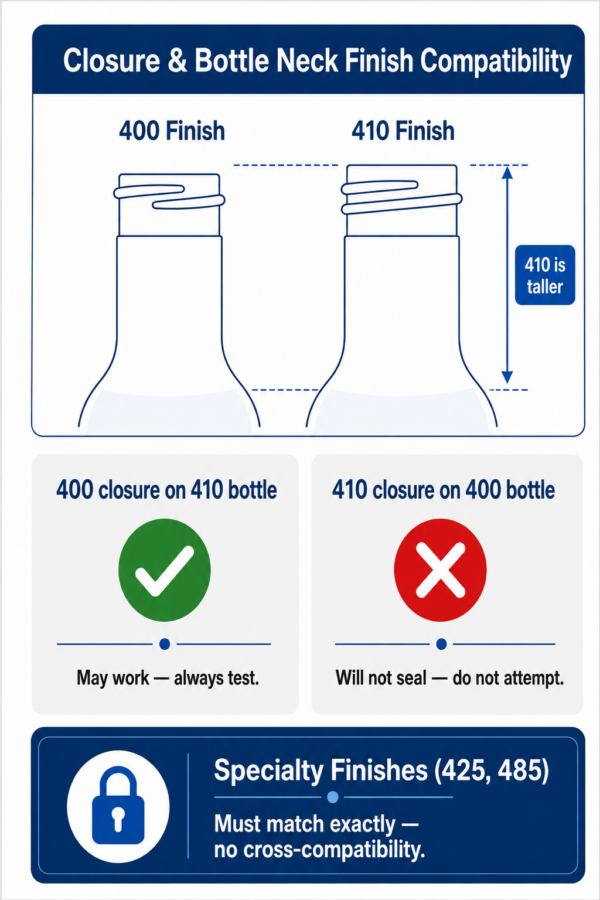
The most common thread styles are 400, 410 and 415. Per industry standards, each number reflects a different thread finish configuration. The 400 has a single thread turn around the neck. The 410 is taller, with one and a half turns. The 415 uses two turns wound more tightly. That difference in thread height determines which closures will fit and how securely they seal.
Neck Finish Preferences by Industry
Different industries tend to favor different neck finishes based on the products they package and the closures they require. Here are some of the most popular neck finishes preferred by industry.

Can You Put a Different-Sized Cap on a Bottle?
You may have wondered if closures and bottles with differing finishes will seal. If the diameter is the same, the answer is yes, in some circumstances.
A 400 finish closure on a 410 finish bottle: This can work. Because the 400 thread profile is shorter, its closure does not engage the full length of the 410 bottle’s neck. It would be a shorter cap on a longer thread, but it could still create a functional seal. Test it with your specific container and product. Never assume a seal without confirming it.
A 410 finish closure on a 400 finish bottle: This does not work. A 410 closure has more thread height than a 400 bottle neck can accommodate. The cap would bottom out and not form a proper seal.
The broader principle: when the closure is shorter than the thread it is going onto, there is room to test. When the closure is taller, there is no path to a seal on the shorter-threaded bottles. It is also worth thinking about appearance. Even when a shorter cap seals correctly on a taller thread, the exposed neck below may not present the right look for your brand packaging.
Specialty finishes: If your container uses a specialty thread style such as a 425 or 485, the closure must match exactly. There is no cross-compatibility with specialty finishes. Knowing your bottle’s exact finish before sourcing closures is essential.
Child-Resistant and Tamper-Evident Closures
If your product requires a child-resistant or tamper-evident closure, neck finish compatibility becomes even more important. Child-resistant closures are engineered to work with specific thread profiles, and the wrong finish will prevent them from functioning correctly. Tamper-evident closures rely on a precise fit to activate properly and give consumers a clear visual indicator of product integrity. Always confirm the required finish before specifying either closure type.
Lug Neck Finishes
Not all neck finishes use a continuous-thread finish (one uninterrupted thread line wrapping around the neck). Lug finishes work differently. Instead of a spiral thread that requires multiple rotations to engage, a lug finish uses a series of short, interrupted threads spaced around the neck of the container. The closure locks into place with a simple quarter-turn or half-turn twist.
This design is particularly common in glass food packaging. Pickle jars, jam jars, pasta sauce jars and other food products with glass containers frequently use lug caps because they are easy to open and close repeatedly without requiring the user to spin the lid multiple times. Lug closures are also well-suited to vacuum sealing, which is why you hear the familiar pop of a metal cap when opening a sealed glass jar.
Because lug finishes are a distinct system from continuous thread finishes, lug caps must match the specific lug configuration of the container. They are not interchangeable with standard continuous-thread closures.
A Team You Can Depend On
Getting neck finish and closure compatibility right at the start saves time, money and the frustration of a reorder. At MJS Packaging, our team works with brands across every industry to make sure containers and closures are matched correctly from day one. If you have a question about compatibility or need help identifying the right finish for your product, contact us today.


Leave a Reply