


Dropper assemblies are versatile dispensing solutions, found everywhere from skincare serums and essential oils to pharmaceutical tinctures and specialty foods. By understanding what a dropper does, how it works and what tip style options are available, manufacturers can make smarter packaging decisions and elevate the experience for their customers.
What Is a Dropper and What Is It Used For?
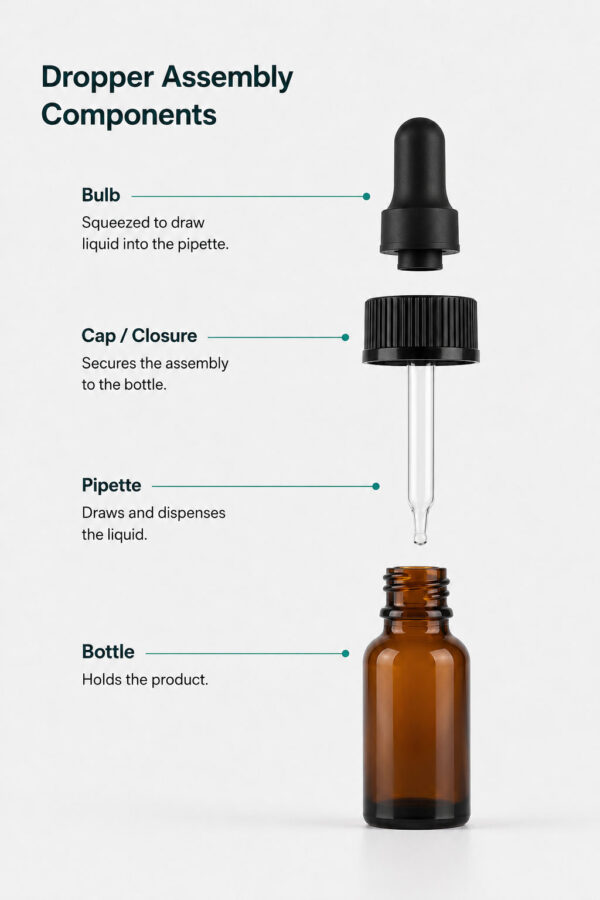
A dropper assembly is a packaging component that dispenses liquid products in small, controlled amounts. It consists of four main parts: a bulb, a pipette, a cap and a bottle. Together, these components give manufacturers and consumers a reliable way to measure and apply liquid products accurately.
Dropper assemblies are a common choice across a wide range of industries. In skincare and cosmetics, they are used for serums, face oils and custom blends. In the pharmaceutical and wellness space, they are the standard format for tinctures, extracts and CBD products. Essential oil brands, specialty food producers and laboratory applications all rely on droppers for their ability to deliver precise, repeatable doses.
How a Dropper Functions
The function of a dropper depends on a simple but effective mechanism. When you squeeze the bulb and release it, the pressure change draws liquid up through the pipette. Squeezing the bulb again releases the liquid in a controlled flow.
The bulb is typically made from rubber or thermoplastic elastomer (TPE). Rubber is the industry standard and suits a wide range of applications, while TPE can offer faster lead times and cost savings for certain projects. Bulb size directly affects the volume drawn, which matters most for applications where dosage accuracy is critical.
The pipette, the tube that draws and dispenses the liquid, comes in glass or plastic. Glass pipettes, particularly those made from borosilicate glass, are ideal for sensitive formulations where chemical resistance is important. Plastic pipettes made from LDPE or PP offer a more cost-effective and durable alternative that works well across many product types.
The pipette should reach close to the bottom of the bottle so that consumers can access as much of the product as possible.
Dropper Assembly Components
Beyond the bulb and pipette, the cap or closure determines how the assembly fits to the bottle and whether it meets specific safety requirements. Continuous thread closures are the standard option and come in a range of neck finish sizes, such as 18-400 or 20-400. Matching the dropper to the correct neck finish is essential for a secure seal and reliable function. For products that require added safety, child-resistant closures are available and help manufacturers meet compliance standards.
Overshells are an optional decorative element that fits over the cap. They are particularly popular in the beauty industry, where metallic finishes and custom colors help a product stand out on shelf and reinforce brand identity.
Choosing the Right Tip Style
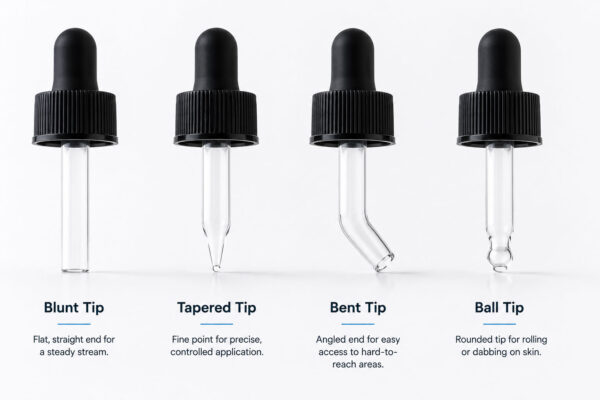
Tip style is one of the most important decisions in dropper assembly selection. The right tip directly affects how the product is dispensed, how easy it is to use and how the consumer feels about the overall experience. There are four primary tip styles to consider.
- A blunt tip has a flat, straight end that dispenses liquid in a steady stream. It works well for general use and is a reliable choice for thicker liquids where high precision is less of a priority.
- A tapered tip narrows to a fine point, making it well suited for precise, controlled application of thinner liquids such as essential oils and tinctures. If your product requires accuracy with every drop, a tapered tip is usually the right starting point.
- A bent tip is angled at the end, making it easier to reach narrow or hard-to-access openings without tilting the bottle sharply. This is useful for products with unusual packaging geometries.
- A ball tip has a rounded end and is designed for rolling or dabbing product directly onto the skin. It is a common choice for spot treatments, face oils and cosmetic applications where direct skin contact is part of the intended use.
Selecting the right tip determines how consumers interact with the product at the moment of use, which directly impacts satisfaction and brand perception.
Matching Your Dropper to Your Product
To choose the right dropper assembly, it helps to work through a few practical questions. What type of liquid are you dispensing and how viscous is it? What volume does a single use require? What is the neck finish size of your bottle and how deep is it? Does the application involve direct skin contact or dispensing into a secondary container?
Answering these questions will help narrow down the right combination of pipette material and length, bulb size, closure type and tip style. For manufacturers in regulated categories such as pharmaceuticals, graduated pipettes with calibration markings are worth considering, as they make precise dosing visible and straightforward for the end user.
Work with MJS Packaging on Your Next Dropper Project
Choosing the right dropper assembly is a decision that touches product performance, regulatory compliance and the consumer experience. MJS Packaging works with manufacturers across industries to source the right components for their products. Contact us today to start a project.